The Process of Learning Maths
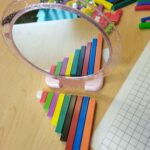
Two overlapping approaches to learning maths developed by Jerome Bruner and Maheesh Sharma will be discussed in this section. As mentioned before, Bruner developed the CPA[1] (Concrete -Pictorial -Abstract) approach. First students are guided to discover maths properties with concrete objects, when learners can physically act upon the objects. This stage Bruner called the “enactive” mode of representation. This stage is important because children when faced with the concept initially, have no point of reference and do not know what to do. By using trial and error, they form the initial shell of the concept, the basic building block. Then learners transfer their skills onto pictorial presentation of objects in the “iconic” mode of representation. This stage is the scaffolding bridge between the concrete and abstract presentations. It also provides the opportunity to build on maths-specific vocabulary necessary for full comprehension of the concept. Finally, once confident, learners are able to code the concepts and properties with symbols in the “symbolic” mode of representation. When students progress through these stages in order, they get a full understanding of concepts and properties. This is where spiralling takes place as well. When learners repeat, or spiral, the material in each stage, which ensures retention and allows for deeper understanding and mastery.
Sharma’s approach echoes the CPA and includes COPA[2] [3] as stages 2-4. The first stage of acquiring a concept is called “intuitive” and is akin to Vygotsky’s “heaps” stage. Yet, the difference here is that the material should be relatable to some prior knowledge of learners to facilitate the intuitive discovery.
The next stage unique to this approach is called “applications”. At this stage the learner is able to apply the maths concept to real life, visualise the concept and solve problems without diagrams provided but rather make their own representation of the problem.
The final stage is called “communication” and presents the highest level of understanding maths. Now learners are able to explain the concept to others. The language of communication is the most varied at this level and students are fluent with definitions and paraphrasing. [4]
Throughout these 6 levels of learning maths, Sharma talks about 3 variables that affect the learning of maths ideas, i.e. linguistic, conceptual and procedural. (Sharma, 2015).
The first variable is the language of maths. Mathematics in itself is highly abstract but to make things worse, maths has its own language, which is very different from a spoken language. Learners need to possess the whole vocabulary of maths, which very often has a different meaning from daily life. Learners must also know how to use this vocabulary correctly to explain their maths operations procedures. Therefore, very often we have to teach children to translate maths symbolic representations into regular situations in daily life. Sharma uses the term “language container” to describe how we start learning a new maths word. He claims that a learner’s maths capacity is directly related to his/her maths vocabulary.
We then commit a meaning to this “language container” and supply it with a related schema of understanding. It first starts with concrete experiences, then the learner repeats it with pictorial presentation and, finally, with abstract maths symbols. This process of internalising the word and the concept is called “mathematization” (Sharma, 2015).
When a learner becomes proficient with a concept, the second variable, this means that a learner has built strong associations between the word and the spatial-quantitative relationships that this word represents. When a learner can transfer skills to new situations, we can conclude that the learner has conceptual understanding and language is the vessel of concept formation.
But the concept does not present itself insolation, rather maths concepts are connected and used to carry out operations. So, a learner has to not only know what the word represents and how it can be used in context but also what maths procedure can be carried out based on the concept. The learner also has to be proficient with the procedure itself and able to repeat it fluently.
In order for all of the tree components to be connected, or for a mathematical idea to be learned, there have to be opportunities present for overlearning.